
Advanced practitioner status
Find out how to apply or reapply for RCVS Advanced Practitioner status, including criteria, application dates, and guidance.
Advanced Practitioner status recognises veterinary surgeons with postgraduate-level knowledge and skills in a defined area of practice. This page explains who can apply, the evidence you’ll need, key deadlines and how the assessment process works.
Advanced Practitioner status is an official recognition of a veterinary surgeon’s knowledge and skills in a specific field of veterinary practice.
Advanced Practitioners hold a postgraduate qualification in their area of interest (or designation), in addition to their first veterinary degree. They also demonstrate a commitment to keeping their knowledge and skills up-to-date.
RCVS Advanced Practitioners are not specialists, but their additional knowledge can be reassuring to animal owners.
You can find a list of Advanced Practitioners on Find a Vet.
You apply for Advanced Practitioner status on MyRCVS.
Applications are open from March to July each year. The deadline for all applications is 31 October.
For your application, you will need:
To qualify for accreditation as an Advanced Practitioner, you must:
Be able to provide two specific examples of clinical governance cases you’ve been involved in.
To achieve Advanced Practitioner status, you’ll need to have had five full calendar years in practice since graduation. You’ll have to be currently working, at least in part, in your chosen designation.
If you graduated in the UK after 2007, you’ll also need to have completed the Professional Development Phase (PDP) or Veterinary Graduate Development Programme (VetGDP).
You will need on average 100 cases per year in your designation for the last five years and will be asked to self-certify that this is the case. These cases should be those where you’ve had primary responsibility.
If you think you can’t meet this requirement, get in touch with us to discuss your situation: [email protected]
You’ll need to hold at least one appropriate post-graduate qualification. Accepted qualifications are:
If you are applying with a non-RCVS qualification that’s not on our list of accepted qualifications, we will need to assess it first. Contact [email protected] for information on how and when you can do this. We approve qualifications for five years, then review them.
If you achieved your postgraduate qualification in 2017 or later, you’ll need to complete module A of the CertAVP (‘Foundations of Advanced Veterinary Practice’) before applying.
We require vets applying for Advanced Practitioner status to present evidence of further study in the key skill of professional development. This means building on what’s included in module A of the CertAVP, or equivalent modules.
Vets applying for Advanced Practitioner status need to demonstrate an ongoing commitment to their development. CPD is an important part of this.
To meet the CPD requirements for Advanced Practitioner status, you’ll need:
Engaging broadly with your community of practice is important. There are lots of CPD activities which count as having an external focus, some examples are:
If you have any problems annotating your previous CPD records, you can email [email protected]
If you’re planning to apply for Advanced Practitioner status but are also planning to take family leave, you have two options:
If you came off the Register or paused your CPD within the period covered by your application, please give us the relevant dates in a covering letter attached to it.
Your Advanced Practitioner application will need to be accompanied by a clinical governance statement. You will create it as a separate document and upload it as part of the process.
The examples you give in your statement should ideally be from cases that were within your designation.
Your statement needs to describe two specific examples of your involvement in clinical governance. It should detail:
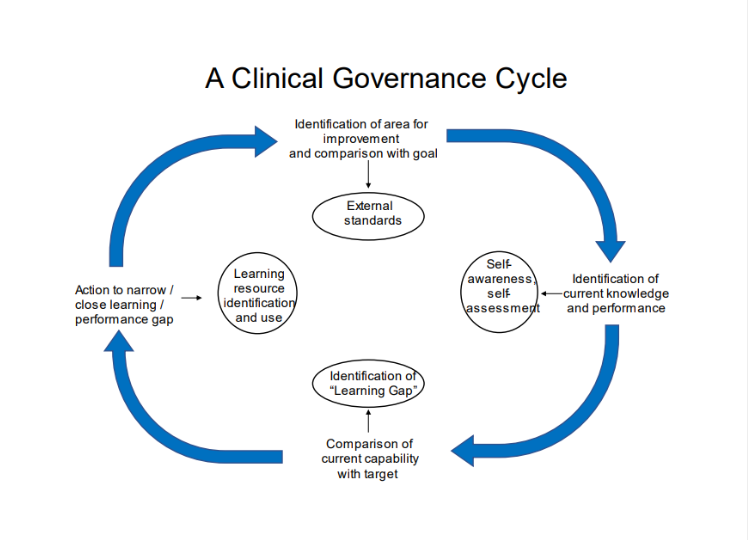
These are the most important sections of the Code to reference when you’re making your clinical governance statement.
1.7 - Veterinary surgeons must ensure that clinical governance forms part of their professional activities
6.1 – a definition of clinical governance
Guidance for individual veterinary surgeons and veterinary nurses, 6.2
Guidance for the veterinary team, 6.3
Completing continuing professional development (CPD) on its own doesn’t provide evidence of benefits for patients or clients. More detail is required if CPD is being used as a clinical governance example.
For example, you might have observed poorer outcomes than published figures for particular types of cases in your designation field. You might then undertake relevant CPD and, through reflection, create a plan of action involving changes to the original treatment. For the purposes of your clinical governance statement, we’d also want to see that you’ve audited the results of the revised protocol to confirm an improvement in outcomes.
Similarly, reports of Morbidity and Mortality Rounds, and revision of treatment protocols, in isolation, do not guarantee changed clinician or team behaviours. We would also need to see either evidence of adherence to those protocols in clinical records or improved patient outcomes, and ideally both.
As part of your application, you will need references to cover the previous five years. You’ll need separate references if you’re applying for multiple designations.
Referees must be currently practising veterinary surgery, must know you professionally and be familiar with your work. We may approach them directly for verification.
Being a referee involves completing and signing a questionnaire.
You will be asked to confirm that:
You can type or handwrite your questionnaire, but it must be returned to the applicant in electronic form. We also accept electronic or typed signatures.
Each question on the form will include guidance in italics. This can be typed over.
Please provide as much detail as possible, including examples of the applicant’s work. This helps our panel come to a decision. We’d recommend completing the questionnaire in electronic form, that way you can write as much as you like in each field.
If you have not known the applicant’s work for a full five years, please state on the form the dates that your reference covers. The applicant will be able to submit more than one reference in these circumstances.
Once you have completed the form, please return the reference to the applicant so they can attach it to their online application.
All applications are considered by a panel of assessors, made up of Advanced Practitioners and RCVS certificate or diploma holders. The panel is representative of a wide range of veterinary disciplines and species areas. The panel chair reports to the Education Committee for final ratification.
We’ll be in touch by email with the outcome of your application. When you’ll hear from us depends on the month you applied.
We’ll let you know in writing if your application is successful. You’ll also be added as an Advanced Practitioner on Find a Vet. You’ll also be able to use the description RCVS Advanced Practitioner on practice websites, stationery and in other places where your status is important.
Being an Advanced Practitioner isn’t a qualification, so we suggest you use it under your name and qualifications, like this:
Mary Jones, BCSc, CertAMP (SAM), MRCVS
RCVS Advanced Practitioner in Small Animal Medicine
To keep your Advanced Practitioner status and remain on the list, you’ll need to reapply for accreditation every five years. See our dedicated reapplication page for more information.
We’ll let you know in writing if your application is unsuccessful, explaining why the assessment panel made that decision. You are welcome to reapply in future, unless the panel specifies that you can’t.
You have 28 days to appeal the decision from the date you receive it. You must submit your appeal in writing to the Registrar, stating your reasons for the appeal as briefly as you can.
Appeals will be considered by an Appeals Panel, which reports directly to the Education Committee. The appeals panel will be made up of people who weren’t on the original assessment panel. The Appeals Panel can’t consider new information in support of your application.
Unfortunately, RCVS staff and members of the panel won’t be able to discuss your unsuccessful application.
There’s both an application fee and an annual fee for being on the list of Advanced Practitioners.
If accepted, your first annual fee is due in the July following your designation.
Fees will not be refunded if your application isn’t successful.
When applying for Advanced Practitioner status, you should choose the designation that reflects your area of practice. There’s an accepted list of qualifications linked to each designation.
You can apply for more than one designation by submitting a separate application form and paying a fee for each one. You’ll need to demonstrate 125 hours of CPD for each designation, in addition to the 250-hour yearly requirement.
Here’s a current list of the options.
If you hold an RCVS Certificate of RCVS CertAVP you can only apply for the designation to which your qualification is linked. Here’s how qualifications are mapped to designations:
Advanced Practitioner Designation | CertAVP | Certificate |
|---|---|---|
Animal Welfare Science, Ethics and Law | Animal Welfare Science, Ethics and Law | Animal Welfare Science, Ethics and Law |
Bovine Reproduction |
| Bovine Reproduction |
Camelid Practice | Camelid Practice |
|
Cattle Health and Production | Cattle | Cattle Health and Production |
Equine Lameness | Equine Lameness |
|
Equine Practice | Equine Practice | Equine Practice |
Equine Surgery – Orthopaedics | Equine Surgery – Orthopaedics | Equine Surgery(Orth) Equine Orthopaedics |
Equine Surgery – Soft Tissue | Equine Surgery – Soft Tissue | Equine Surgery (Soft Tissue) |
Equine Medicine | Equine Medicine |
|
Equine Internal Medicine |
| Equine Medicine (Int. Med) |
Equine Stud Medicine | Equine Stud Medicine | Equine Medicine (Stud Med.) Equine Stud Medicine |
Equine Dentistry | Equine Dentistry |
|
Emergency and Critical Care | Emergency and Critical Care |
|
Fish Health and Production | Fish | Fish Health and Production |
Laboratory Animal Science | Laboratory Animal Science | Laboratory Animal Science |
Pig Medicine | Pigs | Pig Medicine |
Poultry Health and Production | Poultry | Poultry Health and Production |
Production Animal Practice | Production Animal Practice |
|
Sheep Health and Production | Sheep | Sheep Health and Production |
Small Animal Medicine | Small Animal Medicine | Small Animal Medicine |
Small Animal Medicine - Canine | Small Animal Medicine - Canine |
|
Small Animal Medicine - Feline | Small Animal Medicine – Feline |
|
Small Animal Practice | Small Animal Practice |
|
General Small Animal Surgery | General Small Animal Surgery |
|
Small Animal Surgery |
| Small Animal Surgery |
Small Animal Orthopaedics |
| Small Animal Orthopaedics |
State Veterinary Medicine |
| State Veterinary Medicine |
Veterinary Anaesthesia | Veterinary Anaesthesia | Veterinary Anaesthesia |
Veterinary Cardiology | Veterinary Cardiology | Veterinary Cardiology |
Small Animal Cardiology |
| Small Animal Cardiology |
Veterinary Dermatology | Veterinary Dermatology | Veterinary Dermatology |
Small Animal Dermatology |
| Small Animal Dermatology |
Veterinary Diagnostic Imaging | Veterinary Diagnostic Imaging | Veterinary Diagnostic Imaging Veterinary Radiology |
Veterinary Ophthalmology |
| Veterinary Ophthalmology |
Veterinary Public Health | Veterinary Public Health | Veterinary Public Health |
Veterinary Reproduction |
| Veterinary Reproduction |
Zoological Medicine | Zoological Medicine | Zoological Medicine |
We review all accepted qualifications every five years. This list was last reviewed on 10 December 2024. Qualifications will be added to the list as they are approved. Qualifications eligible for RCVS Specialist applications may also be eligible for Advanced Practitioner applications.
If you hold a qualification that’s not on this list, contact [email protected] to discuss your circumstances.
Accepted with no further requirements | Accepted for listing with demonstration of professional key skills required on application* |
|---|---|
RCVS Certificate in Advanced Veterinary Practice, with designation | RCVS Certificate (pre-2012) |
Harper Adams (in partnership with Improve International/ISVPS) Postgraduate Certificates ** in: Exotic Animal Studies Feline Veterinary Studies Small Animal Cardiology Studies Small Animal Dermatology Small Animal Diagnostic Imaging Small Animal Emergency Medicine & Surgery Small Animal Dentistry and Oral Surgery Small Animal Medicine ** Small Animal Ophthalmology Small Animal Surgery** State Veterinary Medicine*** | Membership of the Australian & New Zealand College of Veterinary Scientists in: Cattle Emergency and Critical Care Medicine of Cats Medicine of Horses Sheep Small Animal Medicine Small Animal Surgery Small Animal Dentistry and Oral Surgery Veterinary Anaesthesia and Analgesia Veterinary Behaviour |
Nottingham Trent University Postgraduate Certificate (PGCert) (BSAVA2 )**** | University of Chester Postgraduate certificate in Professional Development in: Small Animal Surgery Small Animal Emergency Practice Small Animal Dentistry Small Animal Diagnostic Imaging |
University of Nottingham Masters in Advanced Clinical Practice (Veterinary) | University of Central Lancashire Postgraduate Certificate in Small Animal Soft Tissue Surgery |
University of Edinburgh MVetSci in Advanced Clinical Practice | University of Edinburgh Masters in Clinical Management of Pain. Additional supporting information is needed for applications with this qualification. Contact us before applying. |
| University of Edinburgh Masters in Clinical Animal Behaviour |
*Those whose qualification was awarded in 2017 or later will need to have completed the ‘A’ module of the CertAVP before applying.
** Provided you have completed the relevant professional skills module and have covered the specific technical content required for Advanced Practitioner status as detailed in the Harper Adams module specification.
*** Awarded in 2021 or later.
**** For qualifications achieved in 2017 or later. If your qualification was awarded in 2016 or earlier, when you apply, you will need to provide evidence that you’ve completed professional skills.